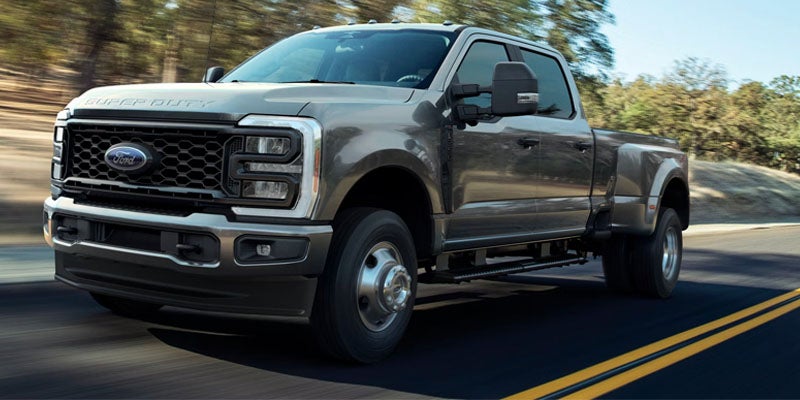
Buying a 2026 Ford Super Duty® means making one engine decision that can dramatically change what the truck does best. Across F-250®, F-350®, and F-450® configurations, Ford offers 2 gas V8s and 2 versions of the 6.7L Power Stroke® V8 Turbo Diesel. Diesel owns the biggest towing numbers, but gas brings some serious payload advantages. For truck buyers around Dahlonega, GA, choosing correctly starts with the weight you're moving and where you're carrying it.
Four V8s, With a Very Large Torque Gap
The gas lineup begins with the 6.8L V8 producing 405 hp and 445 lbs. ft. of torque. The 7.3L V8 increases output to 430 hp and 485 lbs. ft. of torque. Move to the 6.7L Power Stroke® V8 Turbo Diesel and the numbers change dramatically: 475 hp and 1,050 lbs. ft. of torque. The available High Output Power Stroke® reaches 500 hp and 1,200 lbs. ft. of torque at just 1,600 rpm. All 4 engines use a 10-speed automatic transmission. That gives Super Duty buyers a wide capability range without changing truck families.
Heavy Trailers Are Where Diesel Pulls Away
Proper configuration is critical with any towing number, but the maximum ratings show just how much separates these engines. A Super Duty equipped with the 6.8L gas V8 can offer up to 18,900 lbs. of maximum available towing, while the 7.3L gas V8 reaches 22,500 lbs. The 6.7L Power Stroke® can push maximum available towing to 38,600 lbs., and the High Output diesel helps unlock the Super Duty's maximum available 40,000 lb. gooseneck rating. Maximum available fifth-wheel towing reaches 35,000 lbs., while conventional towing can reach 30,000 lbs. For large equipment trailers, substantial fifth-wheels, and frequent heavy towing, diesel's enormous low-rpm torque reserve becomes difficult to argue against.
Payload Gives the Gas Engines Their Own Victory
Here's where simply saying "diesel is stronger" misses part of the story. A diesel engine is heavier, and payload is weight carried by the truck itself. Properly configured Super Duty models with the 6.8L gas V8 can reach 8,000 lbs. of maximum available payload, the highest figure of these powertrains. The 7.3L reaches 7,635 lbs., compared with 6,952 lbs. for the standard Power Stroke® and 6,935 lbs. for the High Output version. Contractors carrying tools, materials, equipment, or substantial bed loads may therefore find that gas gives them more of the capacity they use every working day.
The Power Stroke® Is Built for Frequent Heavy Towing
The standard 6.7L Power Stroke® develops its 1,050 lbs. ft. of torque at 1,600 rpm, while the High Output version delivers 1,200 lbs. ft. at the same engine speed. That low-rpm output is exactly what becomes valuable when a heavy trailer needs to get moving or the road begins climbing through North Georgia. Buyers chasing the largest Super Duty towing ratings will need the diesel and the correct truck configuration. Someone towing well below those limits only occasionally may have less reason to carry diesel capability everywhere they go.
Don't Underestimate the 7.3L Gas V8
The 7.3L V8 deserves a close look because it occupies a useful space between the base gas engine and the Power Stroke®. With 430 hp, 485 lbs. ft. of torque, and up to 22,500 lbs. of maximum available towing, it provides substantial heavy-duty capability without moving to diesel. The 6.8L makes an equally strong argument for payload-focused work, especially with that available 8,000 lb. maximum. Before choosing an engine, compare your actual trailer weight, tongue or pin weight, passengers, tools, and bed cargo against the ratings of the specific truck configuration you're considering.
Compare Super Duty Engines at Chestatee Ford
The 2026 Ford Super Duty gas-versus-diesel decision isn't simply about buying the engine with the largest number. Gas models offer up to 8,000 lbs. of available payload and as much as 22,500 lbs. of towing, while Power Stroke® diesel configurations can reach four-digit torque and 40,000 lbs. of maximum available towing. Visit Chestatee Ford in Dahlonega, GA, to compare available F-250, F-350, and F-450 configurations, review towing and payload requirements, and schedule a test drive online.